
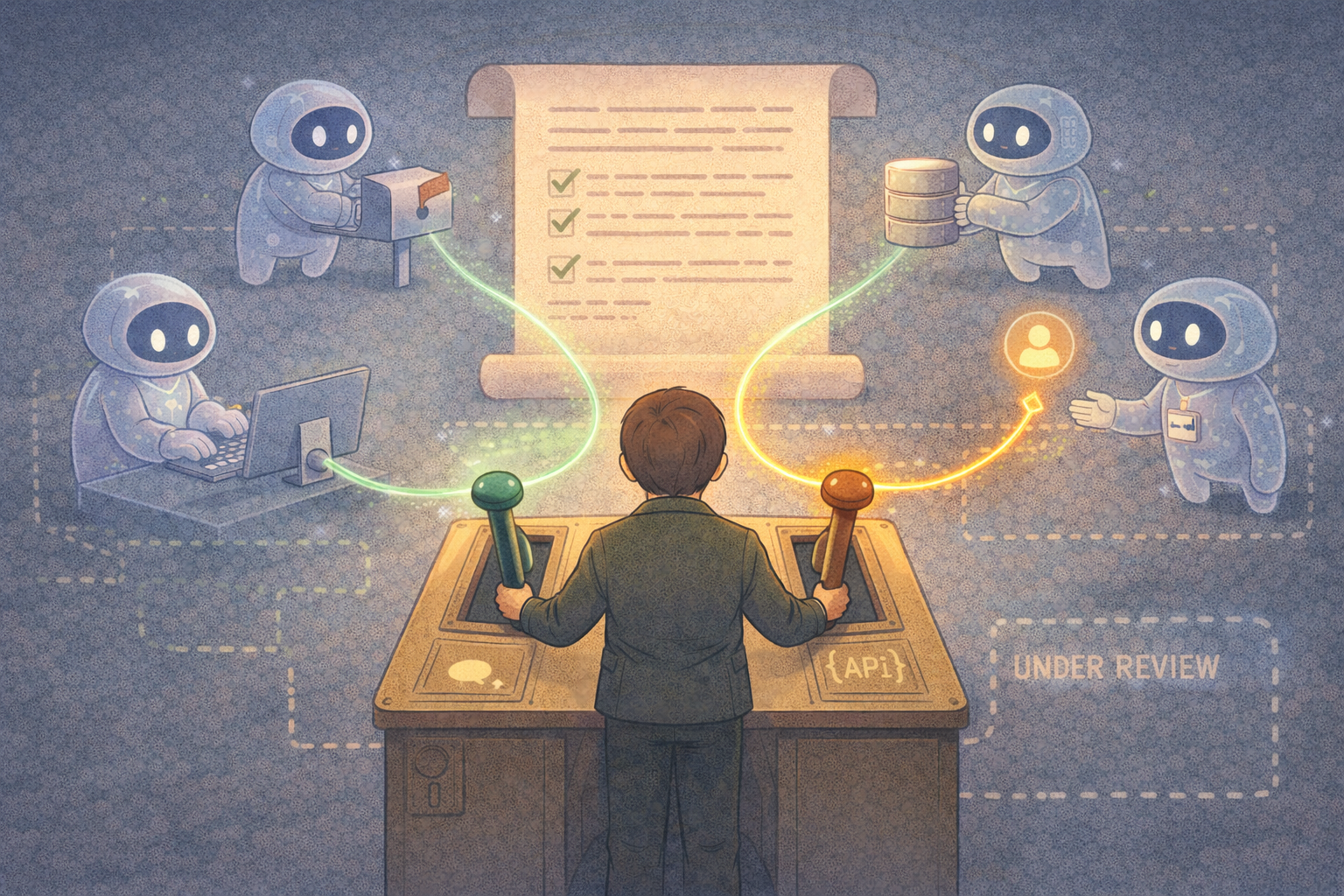
An AI agent processes a customer support request. It accesses the CRM, reads the customer's account history, drafts a response, and sends it. The response contains a commitment the company did not authorize: "I've processed your refund of $847.50 and you should see it within 3-5 business days." Nobody reviewed it. Nobody approved it. The agent had the credentials and the context to act, so it acted.
This is not a hypothetical. Variants of this scenario are happening in production environments right now, across customer support, sales, engineering, and operations. AI agents are deployed. They are taking actions. The question is not whether they should be governed. It is how.
What AI Agent Governance Actually Means
AI agent governance is the practice of enforcing organizational rules on autonomous AI systems that take actions on behalf of your organization. That definition is simple. The implications are not, because agent governance is fundamentally different from the forms of AI governance that came before it.
Traditional AI governance focuses on model development: training data quality, bias mitigation, fairness testing, model validation. It operates during the build phase and produces documentation about how the model was created.
LLM guardrails focus on content generation: filtering harmful outputs, blocking unsafe prompts, detecting toxic language. They operate at the input/output layer of a language model and evaluate text.
AI agent governance focuses on actions, decisions, and consequences. Agents do not just generate text. They call APIs. They modify databases. They send emails. They execute code. They make commitments. They take actions that change the state of systems, relationships, and records. Governance at the action layer is fundamentally different from governance at the output layer because the consequences are not limited to what a user reads. They extend to what the agent does.
When an LLM generates inappropriate text, you have a content problem. When an agent takes an unauthorized action, you have an operational, legal, and compliance problem. The distinction matters because the controls required are different, the evidence required is different, and the cost of failure is different.
Why This Matters Now
Three forces are converging in 2026 that make agent governance an immediate operational requirement rather than a future planning exercise.
Agent adoption is accelerating faster than governance practices can keep up. McKinsey estimates $2.6 to $4.4 trillion in economic value from agentic AI. IBM surveyed enterprise AI developers and found 99% are exploring or building agents. OpenAI's agent frameworks, Anthropic's Claude with tool use, custom agent architectures built on MCP, and enterprise platforms like Salesforce Agentforce and Microsoft Copilot Studio are moving agents from research prototypes to production deployments. The installed base of autonomous AI systems is growing by orders of magnitude quarter over quarter.
Regulatory pressure is not theoretical. It is on the calendar. The EU AI Act requires human oversight mechanisms for high-risk AI systems under Article 14. NIST AI RMF calls for continuous monitoring of AI system behavior. ISO 42001 requires documented governance structures with evidence of operational enforcement. AIUC-1, the emerging certification standard for AI agents, includes specific requirements for agent action control, tool call safety, and audit trails. These are not future aspirations. They are requirements with deadlines.
The attack surface is expanding with every new agent deployment. Agents inherit credentials. They access APIs with the permissions of the users or service accounts they represent. They can be prompt-injected through the data they consume. A compromised or misconfigured agent does not just give bad advice. It takes bad actions with real consequences: unauthorized data access, unreviewed code deployments, financial commitments made without approval, sensitive information disclosed in customer communications.
The Gap in Current Approaches
Most organizations that attempt to govern agents are doing it at the wrong layer. The approaches are familiar because they borrow from adjacent disciplines, but they leave critical gaps when applied to autonomous systems that act.
Permission-based governance defines what the agent can access. It controls which APIs the agent can call, which databases it can read, which tools are in its toolkit. The problem is that access control does not govern behavior. An agent with read access to your CRM can still disclose customer PII in its response. An agent with write access to Jira can create tickets that violate your change management process. Permissions answer the question "can the agent reach this resource?" They do not answer "should the agent take this specific action with this specific data in this specific context?"
Prompt-level governance filters inputs and outputs for safety. It catches toxic content, blocks obviously harmful requests, and enforces basic content policies. The problem is that generic safety filters do not understand organizational context. A safety filter does not know that your company prohibits mentioning competitor names in customer communications. It does not know that financial projections require specific disclaimers. It does not know that your healthcare organization requires AI disclosure language on every patient-facing message. Prompt-level governance enforces universal rules. It cannot enforce your rules.
Post-hoc monitoring logs everything and reviews it later. Dashboards show what agents did. Analytics reveal patterns. The problem is that the damage is done by the time you review it. An unauthorized commitment to a customer already happened. A data leak already occurred. A compliance violation in a regulated communication already shipped. Monitoring tells you what went wrong. It does not prevent it.
The gap across all three approaches is the same: none of them evaluate agent actions against your specific organizational policies in real time, before the action reaches the customer or system.
What Effective Agent Governance Looks Like
Governance that works for autonomous agents requires three capabilities operating together. Missing any one of them creates a gap that agents will find, not maliciously, but because agents optimize for completing tasks, and completing a task sometimes means acting in ways your organization did not authorize.
The first requirement is policy enforcement at the action layer. Every agent output, every tool call, every message gets evaluated against your rules before it executes. Not after. Not in a weekly review. At the moment of action. This requires policies that are machine-readable and enforceable, not PDFs in a shared drive or wiki pages that have not been updated in eighteen months. The policy must be specific enough to evaluate ("customer-facing communications must not contain diagnostic language unless the system is classified as clinical decision support") and connected to the enforcement point where the agent's action passes through before reaching the outside world.
The second requirement is multi-layer evaluation, because not all rules can be checked the same way. Deterministic rules catch patterns: PII formats like Social Security numbers and credit card numbers, credential exposure, blocked phrases, URL patterns, code injection signatures. These are fast, inexpensive, and handle 60 to 70 percent of enforcement checks. Semantic evaluation catches nuance that pattern matching cannot. An AI agent saying "I've confirmed your diagnosis" versus "based on the available information, you should consult your physician" requires understanding meaning, not just matching keywords. Semantic evaluation uses AI to evaluate AI, applying judgment to cases where the rule requires contextual interpretation. Knowledge-based evaluation checks against your specific documents: brand guidelines, regulatory requirements, internal policies. Your organization's rules are unique. Generic guardrails cannot enforce them. Knowledge-based evaluation retrieves your documents and evaluates agent behavior against the specific standards your organization has committed to.
The third requirement is an audit trail generated by default. Every evaluation produces evidence: what content or action was checked, which rule applied, what the evaluation result was, and what enforcement action was taken (blocked, warned, or allowed). This is what auditors and regulators actually want to see. Not that you have a governance policy. That you can prove it is enforced, continuously, across every agent action, with timestamped records linking the policy version to the evaluation result to the enforcement decision.
Getting Started
For teams deploying AI agents today, the path to governance does not start with buying a platform or writing a framework document. It starts with understanding where agents are acting and what rules should apply to those actions.
Inventory your agent surfaces. Where are agents taking actions in your organization? LLM API integrations, code generation tools, email drafting assistants, customer support bots, document creation workflows, internal operations agents. You cannot govern what you do not know exists, and most organizations undercount their agent deployments by a significant margin because agents are embedded in tools that teams adopt without centralized approval.
Start with your existing rules. Your organization already has compliance policies, brand guidelines, data handling requirements, security standards, and operational procedures. These documents contain enforceable rules. Extracting them is faster than writing new policies from scratch, and it ensures your agent governance aligns with the commitments your organization has already made to customers, regulators, and partners.
Enforce before you monitor. Monitoring tells you what went wrong. Enforcement prevents it. Start with the highest-risk surfaces: customer-facing AI outputs where unauthorized commitments or data exposure cause immediate harm, code that touches production where security vulnerabilities or unauthorized changes create risk, and documents that leave the organization where compliance violations become externally visible.
Automate evidence generation. If your governance produces an audit trail automatically, compliance becomes a continuous process rather than a quarterly scramble. When the auditor asks "how do you govern your AI agents?" the answer should not be a policy document. It should be a live report showing every evaluation, every enforcement decision, and every policy version that was active during the audit period.
The Cost of Waiting
AI agent governance is not a future problem. Agents are deployed. They are taking actions. The question is whether your organization's rules apply to those actions or not.
The organizations that get this right will close enterprise deals faster because they can answer the security questionnaire with evidence, not promises. They will pass audits more easily because they have continuous enforcement records instead of assembled-after-the-fact evidence packages. They will avoid incidents because violations are caught before they reach customers, not discovered in a quarterly review.
The organizations that do not will learn about governance the hard way: from an incident, an audit finding, or a deal that died because they could not answer "how do you govern your AI?"
Your organization already has compliance policies, brand guidelines, and security requirements that should apply to AI agent actions. Try extracting enforceable rules from your existing documents and see how many of your requirements can become automated checks today.